Additional menu
Relational Executive Coaching
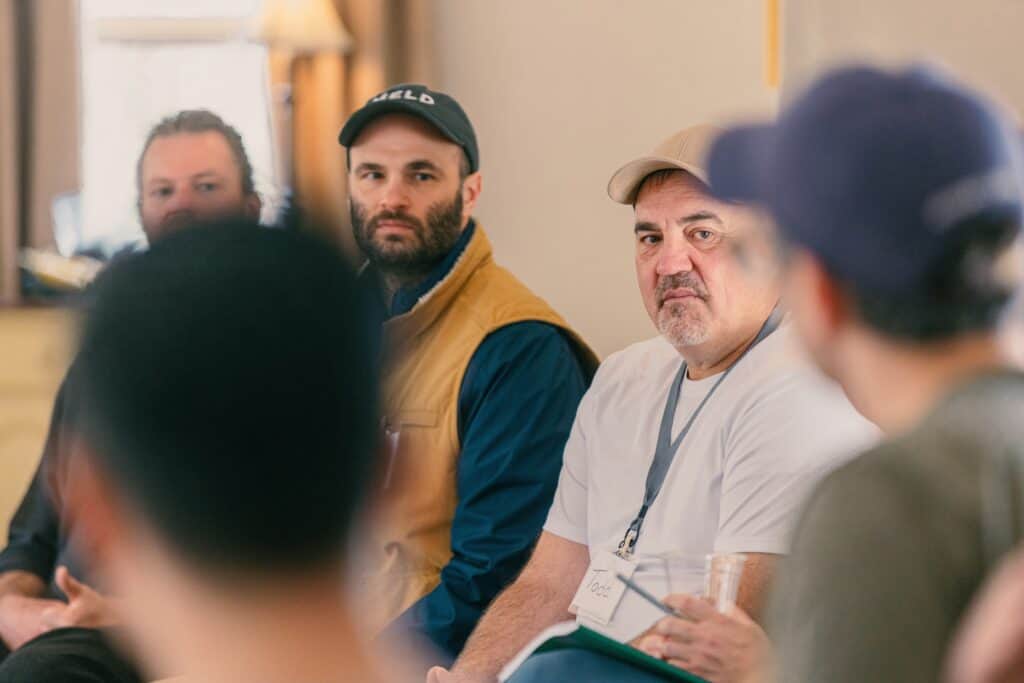
Somatic Coaching with Owen Marcus
What Is Somatic Coaching?
Somatic coaching is a body-based approach to growth and transformation. Unlike traditional coaching that focuses on thoughts and strategies, somatic coaching begins with the nervous system. It recognizes that stress, trauma, and old patterns live in the body as tension, breath restrictions, and unconscious reactions. Change becomes possible when you learn to feel and work with these embodied patterns—rather than just talk about them.
My Path Into Somatic Coaching
More than thirty years ago, before “somatic coaching” was even a term, I was helping men slow down, notice their bodies, and connect sensation to emotion. I discovered early on that men often carried unprocessed experiences in their physiology, shoulders tight, breathing shallow, jaw clenched. When those physical defenses softened, emotions surfaced, and genuine connection became possible.
That simple but radical shift—leading with the body—changed everything. It became the foundation of my work, first in men’s groups, then in training others to facilitate growth, and now through my coaching and through MELD, our global men’s community.
Why Somatic Coaching Is Effective
Somatic coaching is powerful because it works where change actually happens: in the nervous system. Here’s why it’s effective:
- Resets the Stress Response
Chronic stress keeps the body locked in fight, flight, or freeze. Somatic practices help you return to a regulated baseline.
- Reveals Hidden Patterns
Old beliefs and emotional defenses show up as posture, tone, and movement. By bringing awareness to them, you gain choice.
- Creates Authentic Connection
When you can relax your body and open up, relationships transform. Somatic coaching shows you how to connect with yourself and others in real time.
- Integrates Mind and Body
Insight without embodiment rarely lasts. Somatic coaching weaves intellectual understanding with lived experience.
How I Work With You
Every client and every group is different, but the process always starts the same: slowing down and paying attention to what the body is telling us.
I use practices such as:
- Breath awareness and regulation to shift state.
- Micro-movements and posture tracking to uncover unconscious defenses.
- Relational feedback so you can feel how others experience you in the moment.
- Somatic dialogue, asking not just “what do you think?” but “what do you feel in your body right now?”
This is not abstract theory. It’s practical, experiential, and immediately applicable to your daily life.
Somatic Coaching for Men
Men in particular benefit from this work. Many of us were taught to suppress our emotions, to live solely in our minds, and to conceal our vulnerability. That separation often creates stress, leads to failed relationships, and fosters a sense of emptiness, even when outwardly successful.
Somatic coaching gives men a way back:
- To reclaim their own body as an ally.
- To feel deeply without being overwhelmed.
- To connect vulnerably and authentically with others.
It’s why I designed the MELD Method and why MELD’s programs integrate somatic practices at their core.
From Individual to Collective Growth
What began decades ago in my early groups is now part of a global movement. Somatic coaching isn’t just about fixing problems; it’s about building a life of coherence, connection, and contribution.
In one-on-one coaching, we create the safety and clarity for you to discover what your body has been holding and what it’s ready to release. In groups, we amplify this process through community, allowing the nervous system to learn that it can relax, open up, and connect with others.
Begin Where Somatic Coaching Began
If you’re searching for where somatic coaching started and how it continues to evolve, you’ve found it. What was once radical, men healing by feeling, is now recognized as essential.
This is the lineage of my work, and it serves as the foundation for the coaching I offer today.
Somatic Coaching: What Actually Changes—and Why (FAQs)
What is somatic coaching—and why does it work when insight and motivation don’t?
Somatic coaching works because it changes nervous system state before asking for behavior change.
Before we think, the body reacts. Breath tightens or collapses, muscles brace, posture shifts, attention narrows. Under stress, insight alone rarely holds because the nervous system is already organizing perception and action. That’s why people can understand their patterns clearly—and still repeat them.
Somatic coaching starts with physiology—breath, posture, sensation, impulse—and trains the ability to notice and shift state in real time. When regulation comes first, choice becomes available. Across years of individual work and large-scale facilitator training, the pattern is consistent: regulation precedes insight, not the other way around.
Where did somatic coaching come from, and how has it evolved?
Somatic coaching emerged because top-down methods failed under pressure.
From the 1970s onward, body-centered psychotherapy lineages—Hakomi (Ron Kurtz), Somatic Experiencing (Peter Levine), Sensorimotor Psychotherapy (Pat Ogden), and later EFT (Sue Johnson)—converged on the same finding: the nervous system learns through experience, not explanation.
Somatic coaching is the applied evolution of this work. It brings physiology, attachment, and relational regulation into everyday context; relationships, leadership, conflict, and group dynamics where stress is real, and outcomes matter. Functional Men’s Work extends this evolution by insisting on the work function in the conditions people actually live in, not idealized settings.
How did you develop your approach, and how have you trained other somatic coaches?
This method was refined by training people to use it, then fixing what failed.
I helped design and lead the first formal somatic-relational coaching certification at EVRYMAN, where the work was tested at scale across thousands of men and dozens of facilitators. That environment made one thing unmistakable: somatic coaching only works if it holds up under relational pressure.
When I later co-founded MELD, we rebuilt the training using MELD’s somatic pedagogy:
- Body-first regulation (state before story)
- Real-time pattern recognition
- Co-regulation and group dynamics
- Clear ethical boundaries between coaching and therapy
- Translation into practical leadership and relationship behavior
This approach wasn’t theorized; it was stress-tested, iterated, and refined until it reliably worked in real lives.
Why is somatic coaching especially effective for men?
Because men can usually feel their bodies before they can name their emotions.
In both coaching and facilitator training, men often arrive with strong insight but locked physiology: tight jaw, restricted breath, braced chest, collapse under intimacy. Asking about sensation provides a direct, non-shaming entry point. From there, emotion becomes accessible without overwhelm.
Somatic coaching builds capacity to stay present inside discomfort rather than avoiding it or acting it out. This aligns with Functional Men’s Work: meeting men where learning is most accessible, through the body, while restoring agency and choice.
How does somatic coaching support women?
By restoring safety, agency, and relational choice at the level where stress actually lives.
Women often arrive with emotional awareness but a nervous system shaped by chronic vigilance, relational over-functioning, or shutdown. Somatic coaching helps re-establish internal safety and choice, so connection is no longer maintained at the expense of the body.
Because the work is state-based rather than role-based, it supports women in reclaiming boundaries, voice, and presence without forcing performance or emotional labor.
What body-based patterns do you consistently see in high-functioning adults?
The same protective strategies show up across backgrounds and roles.
Common patterns include chronic bracing, shallow breathing, collapse or numbness during conflict, speed as avoidance, and performance posture that hides exhaustion or fear. These are not flaws; they are learned survival strategies.
Somatic coaching teaches people to recognize these patterns as they arise and update them safely, restoring access to connection, clarity, and effective action.
What actually happens in somatic coaching sessions?
Sessions train three skills that transfer directly to life.
- Accurate self-tracking (without fixing or narrating)
- State shifting (simple, repeatable regulation moves)
- Translation under pressure (using these skills in real conversations and decisions)
In group settings, co-regulation accelerates learning. This is central to MELD pedagogy: community is part of the mechanism, not an add-on.
How does somatic coaching create lasting change?
Lasting change happens when the nervous system learns a new default.
Under threat, options narrow. Somatic coaching works directly with the stress response so people can remain themselves under pressure. When regulation is accessible, old reactions stop repeating. This is the core of Functional Men’s Work: building capacity, not compliance.
How does this work relate to Polyvagal Theory, attachment, and trauma science?
These frameworks explain why state drives behavior; somatic coaching teaches what to do about it.
Polyvagal Theory clarifies shifts between connection, mobilization, and shutdown. Attachment explains how early relationships shape those shifts. Trauma science shows what happens when systems get stuck. Somatic coaching operationalizes this knowledge—training people to recognize state, shift it, and repair connection in real time.
How does somatic coaching improve relationships and leadership?
Relationships and leadership are nervous-system events.
When stressed, people listen less, defend more, misread cues, and try to control outcomes. When regulated, they become clearer, more responsive, and trustworthy. Across years of group facilitation and coach training, one truth stands out: presence is contagious.
Why are group work and community essential to somatic change?
Humans regulate in relationships.
Group work provides live co-regulation and feedback that individual work cannot. In MELD’s Functional Men’s Work, people practice regulating themselves while staying connected—learning to support without fixing or posturing. Community becomes medicine because it directly shapes physiology.
Is somatic coaching therapy?
No—and clarity here protects everyone.
Dimension | Somatic Coaching | Therapy (Psychotherapy) | Life Coaching |
Primary focus | Regulation, embodiment, real-time pattern change | Mental health treatment, trauma resolution, diagnosis | Goals, mindset, accountability |
Starting point | Body first (physiology/state) | Mind, emotion, history, symptoms | Mindset, values, outcomes |
Core mechanism | Bottom-up learning: physiology → choice | Insight, emotional processing, clinical methods | Motivation, strategy, reframing |
Nervous system work | Explicit, implicit, and continuous | Modality-dependent | Rare |
Time orientation | Present-moment patterns | Past + present | Future goals |
Trauma relationship | Builds capacity; not clinical treatment | Clinical treatment | Generally not trauma-informed |
Use of diagnosis | None | Often central | None |
Best fit | When insight exists but stress hijacks behavior | When clinical care is needed | When capacity is high and stress is low |
Typical outcome | Regulation, presence, relational capacity | Symptom reduction, stabilization | Goal attainment |
Somatic coaching supports growth, stress capacity, relationships, and leadership when someone is stable. Licensed therapy is appropriate for acute trauma, severe dissociation, active addiction, or psychiatric instability. Ethical somatic coaches know this boundary and refer accordingly.
If a client can utilize their physiology as an asset, then some of the approaches of a traditional coach can be applied. With a down-regulation of stress or trauma, conventional coaching methods become sustainable.
How long does somatic change take—and what shifts first?
Awareness first, capacity next, choice last.
Most people notice earlier stress signals within weeks. Over time, they can stay present longer without collapsing or attacking. Durable change comes through repetition and relational safety, not force or motivation. Change can surpass sustainability to be generative; the new behaviors continue to improve on their own.
How are somatic coaches trained, and how should I choose one?
Training quality matters more than technique lists.
Look for supervised practice, nervous-system and attachment training, clear scope boundaries, and experience with relational and group dynamics. Having trained facilitators myself, I can say plainly: somatic coaching requires capacity and presence under pressure, not just tools.
Somatic Coaching vs Therapy vs Life Coaching
These approaches are not enemies. Life coaching works best when stress is low and capacity is high. Therapy is essential when clinical treatment is needed. Somatic coaching fills the gap many people face: they understand their patterns, but their body still takes over under pressure.